Fraud targeting older Americans has reached a staggering scale. Behind every statistic is a person who may have lost retirement savings, financial independence, or the ability to trust those offering help. Understanding the size and nature of the problem can help older adults, families, caregivers, and financial institutions recognize the warning signs before money is lost.
The figures below come primarily from the FBI’s 2025 Internet Crime Report and the Federal Trade Commission’s Protecting Older Consumers 2024-2025. Additional analysis is credited to Stolen Trust: A Special Study on America's Elder Fraud Landscape, a 2026 study published by Human Cybersecurity Knowledge for Seniors, or HCSK.
Elder Fraud in America: The Big Picture
According to the FBI’s Internet Crime Complaint Center, commonly known as IC3, Americans age 60 and older reported the following in 2025:
-
$7.748 billion in total losses
-
201,266 complaints
-
A 59% increase in losses from 2024, when reported losses totaled $4.885 billion
-
An average loss of approximately $38,500 per complaint
-
12,444 complaints involving losses of more than $100,000
Adults age 60 and older accounted for approximately 20% of all IC3 complaints in 2025, but 37% of all reported losses. No other age group tracked by the FBI reported greater total losses.
These figures represent only the incidents reported to the FBI. The actual number of victims and total amount stolen are almost certainly much higher.
The Most Costly Scams Affecting Older Adults
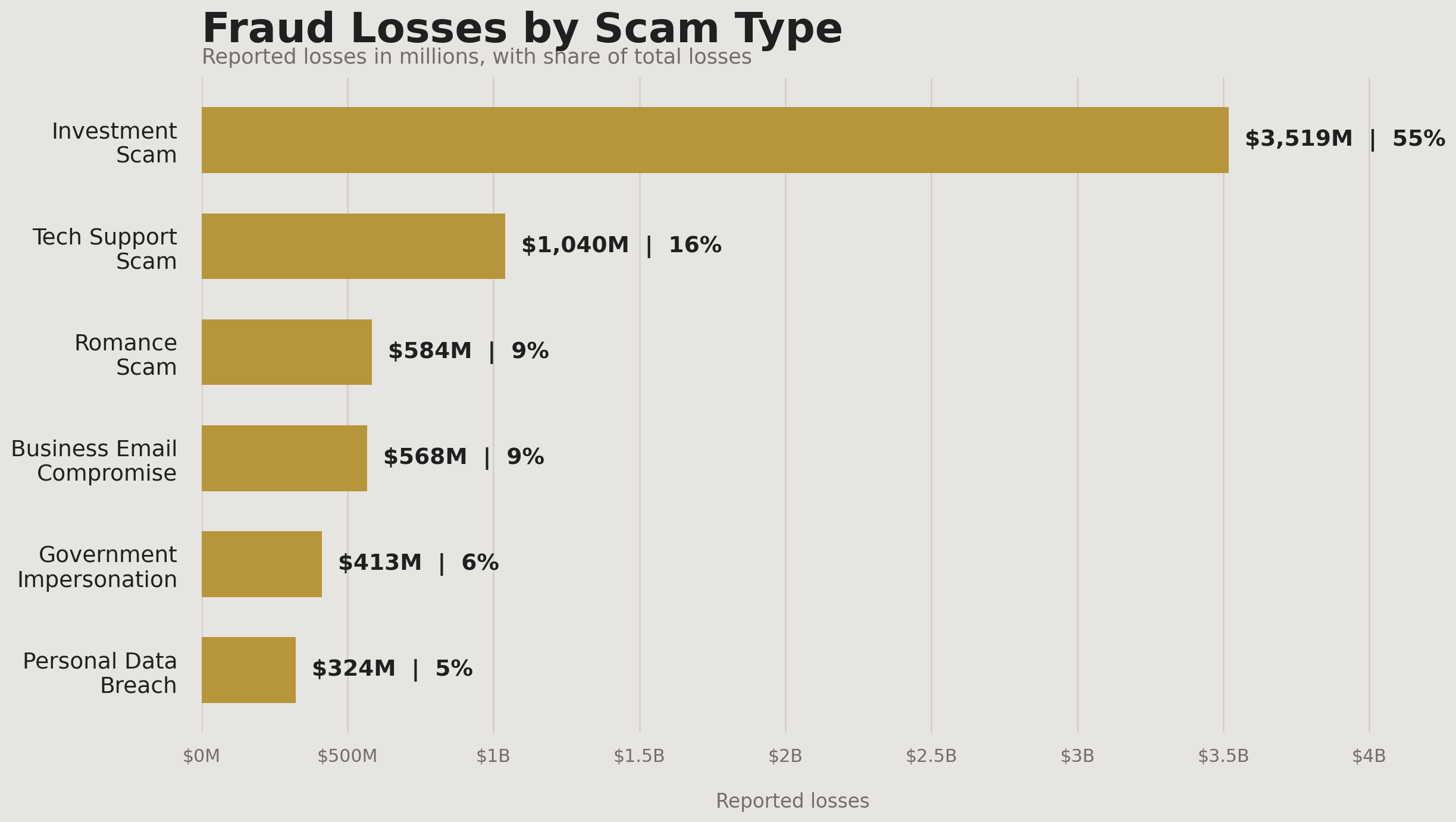
Investment scams caused more financial damage to older Americans than any other fraud category in 2025. Reported investment-fraud losses reached $3.519 billion, representing approximately 45% of all reported losses among people age 60 and older.
Tech support scams were a distant second, but still crossed the billion-dollar mark. Romance scams, business email compromise, government impersonation, and personal data breaches also caused hundreds of millions of dollars in reported losses.
Reported 2025 losses among adults age 60 and older. Percentages shown represent each category’s share of the six scam types included in the chart. Source: FBI Internet Crime Complaint Center, 2025 Internet Crime Report.
The True Cost May Be Much Higher
FBI and FTC statistics measure different pools of consumer reports, so their totals should not be compared as if they came from a single reporting system. Together, however, they reveal the same problem: only a fraction of fraud is reported.
According to the FTC’s December 2025 report:
-
Older adults reported nearly $2.4 billion in fraud losses during 2024, up from approximately $600 million in 2020.
-
The median reported loss among adults age 60 and older was $900.
-
For adults age 80 and older, the median reported loss reached $1,650.
-
After accounting for underreporting, the FTC estimated that fraud may cost older adults between $10.1 billion and $81.5 billion annually.
Many victims never report what happened. Some feel embarrassed or fear losing their independence. Others do not realize they have been deceived, especially when a scam develops slowly through a relationship or supposed investment opportunity.
The FTC has also found that although older adults may be less likely than younger people to report losing money in some types of fraud, they frequently lose much larger amounts when they do.
Six Elder-Fraud Trends to Watch
1. Cryptocurrency is driving enormous losses
The FBI recorded 42,271 cryptocurrency-related complaints from adults age 60 and older in 2025, resulting in $4.35 billion in losses.
Older adults filed approximately 23% of all cryptocurrency complaints but accounted for roughly 38% of cryptocurrency-related losses. This indicates that when older victims become involved in these schemes, the financial consequences are often particularly severe.
Cryptocurrency may be presented as the investment itself, but it is also frequently used simply as the payment method. Scammers favor it because transactions can move quickly and may be difficult to reverse.
2. Investment fraud is the dominant threat
Reported investment-fraud losses among older adults increased from $1.834 billion in 2024 to $3.519 billion in 2025, a year-over-year increase of approximately 92%.
Investment scams now account for nearly half of every dollar reported lost by people age 60 and older. Many begin through social media, text messages, dating platforms, or unsolicited investment groups. Victims may initially be allowed to withdraw a small amount of money, creating the illusion that the investment is legitimate before they are encouraged to invest much more.
3. Tech support losses exceeded $1 billion
Older adults reported approximately $1.041 billion in tech support scam losses during 2025, up from about $982 million in 2024.
These scams often begin with a pop-up, email, or phone call warning that a computer, bank account, or identity has been compromised. The criminal then offers to “fix” the problem or move the victim’s money into a supposedly secure account. In reality, the warning and the solution come from the same scammer.
4. Artificial intelligence is making deception more convincing
For the first time, the FBI’s 2025 report included an “AI Related” designation. Across all age groups, IC3 received 22,364 AI-related complaints representing approximately $893 million in losses.
Among adults age 60 and older, the FBI recorded 3,143 AI-related complaints and $352.5 million in losses.
These figures likely understate the problem because victims may never know that artificial intelligence was involved. Voice cloning, fabricated videos, realistic images, and AI-generated messages are making romance, investment, family-emergency, and impersonation scams more convincing.
The safest response to an urgent request is to pause and independently contact the person or organization using a telephone number or website you already trust.
5. Scammers are returning to previous victims
Recovery scams target people who have already lost money. The criminal may claim to be an attorney, government investigator, recovery company, or cybersecurity specialist who can retrieve the stolen funds.
The offer usually requires an upfront payment, processing fee, tax, or deposit. Once that money is sent, the supposed recovery agent disappears, or demands additional payments.
An unexpected promise to recover lost money, especially one requiring advance payment, should be treated as a likely scam.
6. Speed matters when money has been sent
The HCSK Stolen Trust study found that recovering stolen money often depends on reporting the transaction within hours. In cases that reached the FBI’s Financial Fraud Kill Chain quickly enough, approximately half of the funds at risk were frozen.
However, the amount frozen across those incidents represented less than one-half of 1% of the $7.748 billion reported lost by older adults during the year.
If money has been transferred to a scammer, immediately contact the financial institution involved and report the incident to law enforcement. Waiting until the next day may significantly reduce the chance of recovery.
What These Numbers Mean for You
Fraud prevention does not require distrusting everyone. It requires slowing down when someone creates urgency, fear, excitement, or pressure.
A few habits can make an enormous difference:
-
Learn: Become familiar with common scam tactics through trusted security education.
-
Communicate: Talk openly with family members about suspicious calls, messages, and investment offers.
-
Pause: Do not allow urgency or threats to force an immediate decision.
-
Verify: Contact the person, business, bank, or government agency independently.
-
Protect: Never provide passwords, verification codes, remote access, or financial information in response to an unexpected contact.
-
Report: Report scam attempts even when no money was lost. Each report may help investigators identify patterns and protect future victims.
If you believe fraud is occurring, contact the financial institution involved immediately. Reports can also be filed with the FBI at IC3.gov and with the FTC at ReportFraud.ftc.gov.
Elder fraud thrives on urgency, manipulation, and silence. Education and open communication remove all three advantages.

 SUBSCRIBE TO WEEKLY NEWSLETTER