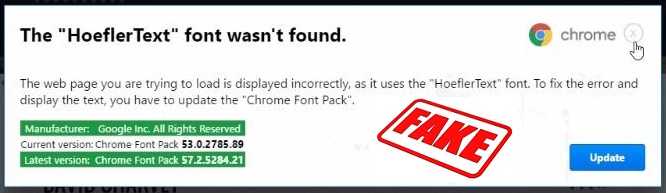
The fraudsters are at it again with a clever new trick for Chrome users. In this one, they convince the user to click on a font installer package to “fix” broken fonts when they visit certain poorly secured websites.
They do this by inserting some code inside the pages that includes characters that are not recognized by the Chrome browser. Then, the page is redirected to one of their pages where a popup dialogue appears requesting the user to install a special “font package” to correct the unreadable text. However, what really happens is click fraud adware gets installed on the device.
While the adware isn’t particularly dangerous, it is annoying because it causes the user’s device to become a tool for committing click fraud by the cyber criminals. Every time an ad is clicked, money goes into the pockets of the scammers.
This version of the scam may be only the beginning. It can be used for far more nefarious tactics, should those behind it choose to use it in that way.
 There are lessons with this for both end users and those who are responsible for maintaining a company’s website. For the end users, always be aware of the dialogue in popup windows and don’t get in a rush to click them away. It’s easy to get overwhelmed with day-to-day tasks, but take the time to read the text and understand it If you are suspicious in any way, click the “X” to close the browser window. Don’t click any of the responses given in the box. If there is no option to click and “X,” close the entire browser and re-open it. Then try your website again. It would be very unusual to get a broken font message, regardless of the browser being used.
In addition, install anti-malware and anti-virus software on all devices and keep it updated.
For those maintaining websites, always keep them updated with the latest patches and operating system (OS) and software versions and the developer supports everything used to keep it going. Once it is no longer a supported version of the software or OS, the developer will no longer produce security patches. This leaves the site vulnerable to attacks such as this one, as well as other, potentially more dangerous ones.
Right now, users of Mac can breathe a bit easier, as they are not currently vulnerable to this. It also appears that this is being seen in English speaking countries and has been spotted in Australia, Canada, the U.K., and the US, according to security company Proofpoint. However, it’s likely not long before it expands to other countries and languages.
For banks and credit unions
Share this article with your members
Copy a ready-made summary and link for your newsletter, website or social posts.