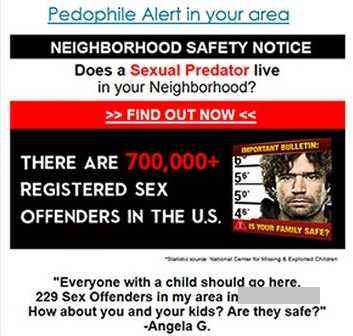
With the world so interconnected these days, phishing scams are not limited to a particular area or country. In a recently sighted phishing case, an email is going around to users in the U.K. claiming that those clicking a link can find where the pedophiles are living in their areas. It was a bit obvious to those who paid attention that it was fake; because the verbiage used US English, which consists of slightly different spellings for various words, such as “neighborhood” in the US vs. “neighbourhood” in the U.K. That said, some are still falling for it.
The email in this case has a note asking “Does a sexual predator live in your neighborhood? Find out now” and includes a link to click. However, it’s all an attempt to steal personal details.
Be sure that in the United States, there are indeed websites for finding out information about convicted registered sex offenders. However, unlike this unsolicited email going around, no law enforcement agency will send a bulletin via email with a link to these registries. Looking at them is entirely voluntary and government agencies do not send email with such information in an unsolicited manner.
 Don’t click on any links in email messages that are from unfamiliar senders, are suspicious at all, and/or are unexpected. Even if the sender appears to be familiar, such as a government office, if you didn’t initiate the communication, don’t assume any links contained inside are safe.
If you really want to find out where registered sex offenders are located in your community, go to the website for your state. Each state has its own way to disseminate this information. The website addresses are located at the Department of Justice website or on the National Sex Offender Public Website (NSOPW).
Officials warning of this scam believe the email addresses used to do the spamming in this case were retrieved somehow from social media, although it could have been from any number of breaches that have happened in recent years. In any case, it’s important to take a moment to be sure the messages aren’t merely using scare tactics in an attempt to steal login credentials, payment card numbers, or other sensitive information. Take some time to review email messages to ensure they’re from a source that is trusted, are expected, and that the links go to where you think they should. You can determine this by hovering the mouse pointer over the link or by holding down on it for several seconds if you have a touch screen. If you think it should go to your bank, but the address points to somewhere entirely different, it’s rubbish.
For banks and credit unions
Share this article with your members
Copy a ready-made summary and link for your newsletter, website or social posts.