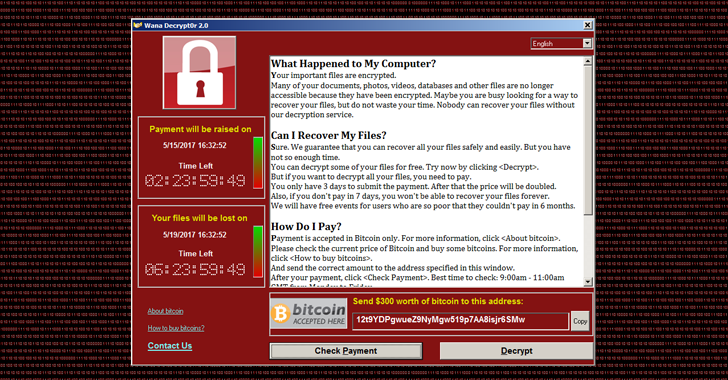
A recent event certainly demonstrates how cybercriminals are constantly adapting their tactics to infiltrate organizations and continue their ways. Officials in the United Kingdom (UK) are reporting a widespread cyberattack affecting healthcare organizations, including hospitals across the country. Employees of several hospitals there have reported their computer screens locking up and a ransomware note appearing asking for around $300 (£230) to unlock them.
The BBC is reporting that this is a worldwide incident affecting organizations in not only the UK, but also the U.S., China, Russia, Spain, Italy, Vietnam, and others. Some security researchers have reported seeing up to 36,000 instances of a piece of ransomware referred to as “WannaCry,” “Wanna Decryptor,” ‘WCry,” and other variations on that name.
This is an ongoing situation, so more details will be coming out over the next hours, days, and weeks. However, per the BBC, some experts who are monitoring this said the hackers took advantage of a Microsoft vulnerability released a while back by the hacking group The Shadow Brokers. This is the same group that claims to have released a batch of hacking tools used by the National Security Agency (NSA) in the U.S.
Reports in the Telegraph UK reported that a hospital in Kent claimed users were clicking on email messages with "Clinical Trials" in the subject and subsequently spreading the malware around.
 Microsoft did release a patch for that particular vulnerability in March. However, not everyone has applied it and this is an example of why it is so important to apply those as soon as possible. In this case, the ransomware could contribute to more harm or even death.
Since it isn't clear how this ransomware is making its way around, be extra cautious, regardless of your industry about clicking links or attachments in email messages that are unexpected, come from unfamiliar senders, or about which you cannot be 100% certain they are safe to click. If the subject has nothing to do with your job functions, email messages should be considered suspect and met with skepticism.
Patients are still able to get some services with reports of doctors using the “old fashioned” pen and paper to take notes while the computers are down. However, officials are requesting that anyone needing medical or dental care hold off for the time being, unless it is an emergency situation.
For banks and credit unions
Share this article with your members
Copy a ready-made summary and link for your newsletter, website or social posts.